NVIDIA RTX Spark: The AI Laptop Chip That Could End Cloud Dependency Forever
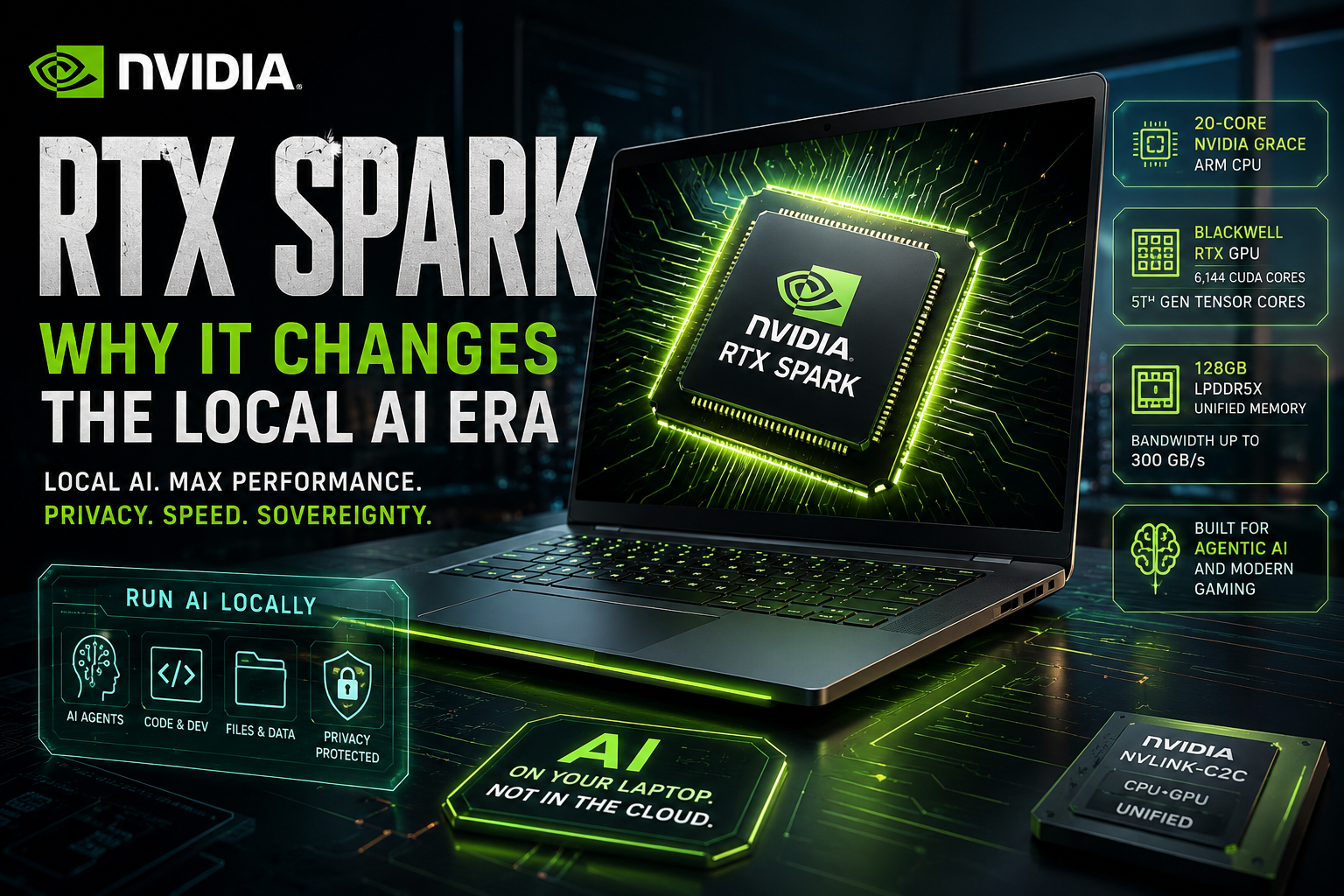
NVIDIA RTX Spark could be the biggest shift in AI computing since the rise of cloud-based services. For the past three years, the tech industry has convinced us that powerful local hardware was no longer necessary. As long as you had a stable internet connection and another monthly subscription, cloud servers would handle the heavy lifting. Expensive gaming PCs and premium laptops gradually became little more than gateways to remote data centers.
Now, in the second half of 2026, that mindset is changing fast.
Cloud AI is starting to show its limits. Developers deal with API latency. Gamers are tired of endless subscriptions. Businesses worry about privacy. Even casual users are asking why their personal files need to travel across the internet just to complete simple AI tasks.
Welcome to the era of Agentic AI—where AI doesn’t just answer questions but performs complete workflows directly on your computer.
To make that possible, local hardware needs a massive upgrade. At Computex 2026, NVIDIA introduced exactly that with the RTX Spark.
Instead of building another traditional laptop processor, NVIDIA combined a powerful ARM CPU with a Blackwell-based RTX GPU into one unified platform. The result isn’t simply another AI PC—it’s hardware designed for the next generation of local AI computing.
Why Cloud AI Is No Longer Enough
The software world has changed dramatically over the last two years.
Back in 2024 and 2025, AI mostly worked as a chatbot. You asked a question, copied the response, and pasted it into your project.
That workflow feels outdated today.
In 2026, users expect AI to complete entire tasks without constant supervision. These autonomous assistants—often called AI agents—can browse folders, modify code, organize files, and automate repetitive work.
One of the biggest examples is OpenClaw, an open-source AI agent framework that quickly became popular among developers and power users.
Unlike traditional chatbots, OpenClaw integrates directly with the operating system. It can execute shell commands, manage files, schedule background jobs through its Heartbeat feature, and automate complex workflows.
However, there’s one major problem.
Running an AI agent through cloud services means constantly uploading sensitive information while paying expensive API fees. Every project, source code repository, document, or personal file becomes another request sent to remote servers.
Running the AI locally solves both issues.
Unfortunately, large AI models have always required desktop-class hardware with multiple GPUs and massive VRAM. Until now, laptops simply couldn’t keep up.
That’s exactly the problem the NVIDIA RTX Spark was built to solve.
NVIDIA RTX Spark Hardware Explained
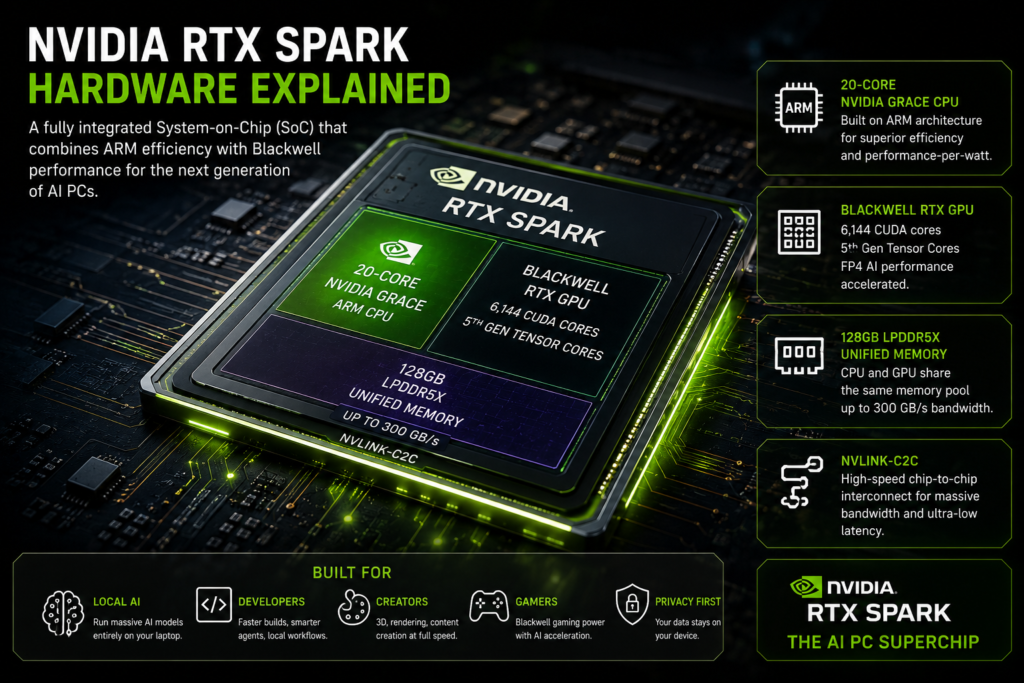
The RTX Spark isn’t just another CPU paired with a mobile GPU.
It’s a fully integrated System-on-Chip (SoC) that brings ARM efficiency into premium Windows laptops while delivering workstation-level AI performance.
For years, Windows-on-ARM struggled to attract gamers and creative professionals. NVIDIA is taking a completely different approach by combining custom ARM silicon with its Blackwell graphics architecture.
The flagship NVIDIA RTX Spark, internally known as the N1X Superchip, includes:
- 20-core NVIDIA Grace CPU built on ARM architecture, replacing the traditional x86 design used by Intel and AMD for significantly better performance per watt.
- Blackwell RTX GPU featuring 6,144 CUDA cores alongside fifth-generation Tensor Cores optimized for FP4 AI workloads.
- 128GB LPDDR5X Unified Memory, arguably the most important feature of the entire platform.
NVIDIA RTX Spark Unified Memory Changes Everything
Traditional gaming laptops split memory into two separate pools.
For example, you may have:
- 32GB of system RAM
- 16GB of dedicated GPU VRAM
If your AI model requires 24GB of VRAM, the GPU simply runs out of memory—even if plenty of system RAM is still available.
RTX Spark eliminates that limitation.
Using NVIDIA’s NVLink-C2C interconnect, both the CPU and GPU share a unified memory pool of up to 128GB, with bandwidth reaching 300 GB/s.
For the first time on a Windows laptop, the GPU can dynamically access over 100GB of memory whenever demanding AI workloads require it.
That opens the door to running enormous open-source language models locally, including models capable of handling context windows approaching one million tokens.
Imagine pointing an OpenClaw agent at an entire software project and asking it to refactor the architecture. Instead of uploading everything to cloud servers, RTX Spark performs the entire workflow locally—faster, privately, and without recurring API costs.
RTX Spark Is Also Built for Serious Gaming
Although AI is the headline feature, gamers aren’t being left behind.
The Blackwell GPU inside RTX Spark delivers modern gaming performance while taking advantage of technologies that didn’t exist just a few years ago.
Today’s graphics industry is moving beyond traditional rasterization toward Path Tracing, which simulates realistic lighting by tracking light from its source instead of the camera. The result is dramatically more lifelike reflections, shadows, and global illumination.
Running path tracing on a laptop would normally be unrealistic.
That’s where DLSS 4.5 and Ray Reconstruction come into play.
Powered by fifth-generation Tensor Cores and an advanced Neural Processing Unit (NPU), RTX Spark can process AI-assisted rendering much faster than previous mobile platforms.
According to NVIDIA, the platform targets 100 FPS at 1440p in modern AAA games while maintaining the power efficiency needed for thin-and-light laptops with all-day battery life.
Instead of forcing the GPU to handle every rendering task alone, dedicated AI hardware accelerates frame generation, image reconstruction, and ray tracing. That allows the ARM CPU and Blackwell GPU to focus on core rendering performance.
The result is a laptop that delivers gaming power without the bulky chassis, loud cooling systems, or poor battery life traditionally associated with high-performance gaming machines.
Also read about this issue:
Don’t Buy RTX 5060 in 2026 Until You Read This!
Hong Kong AI Hardware Revolution 2026: Biggest Innovations Changing the Future
Why Local AI Matters More Than Ever
RTX Spark isn’t just about higher frame rates or faster AI benchmarks.
It represents a much bigger shift toward System Sovereignty.
In 2026, data has become one of the world’s most valuable resources.
Whenever cloud AI analyzes source code, financial documents, business plans, or creative assets, that information leaves your computer and travels to third-party servers.
Many organizations have already tightened security policies because of those risks.
RTX Spark changes that equation.
Future devices from Microsoft, Dell, ASUS, and other manufacturers are expected to combine RTX Spark with secure local AI environments that give users complete control over how AI agents access files and system resources.
Whether you’re generating textures in Adobe Substance 3D, editing videos, writing code, or automating infrastructure management with OpenClaw, your data stays on your own machine.
Instead of acting as a simple gateway to cloud services, your laptop becomes an intelligent local workstation capable of handling enterprise-level AI tasks offline.
Is This the Beginning of the End for x86?
RTX Spark also raises an important question:
Does the future still belong to x86 processors?
Intel and AMD won’t disappear overnight. Enterprise software still depends heavily on x86 compatibility, and millions of existing applications continue to rely on that ecosystem.
However, consumer computing is clearly moving in a different direction.
Microsoft continues to improve Windows-on-ARM, while the Prism emulator significantly reduces compatibility concerns for older 32-bit and 64-bit applications.
When you combine:
- ARM-level battery efficiency
- Blackwell gaming performance
- Massive unified memory
- Local AI acceleration
…traditional gaming laptops begin to feel increasingly outdated.
RTX Spark isn’t just another hardware launch.
It’s a new foundation for how future PCs will operate.
By bringing server-class AI capabilities into a portable laptop, NVIDIA is shifting AI away from centralized cloud infrastructure and putting that power directly into users’ hands.
For gamers, creators, developers, and AI enthusiasts alike, NVIDIA RTX Spark could become one of the most important PC innovations of the decade.
Source: NVIDIA Official Website