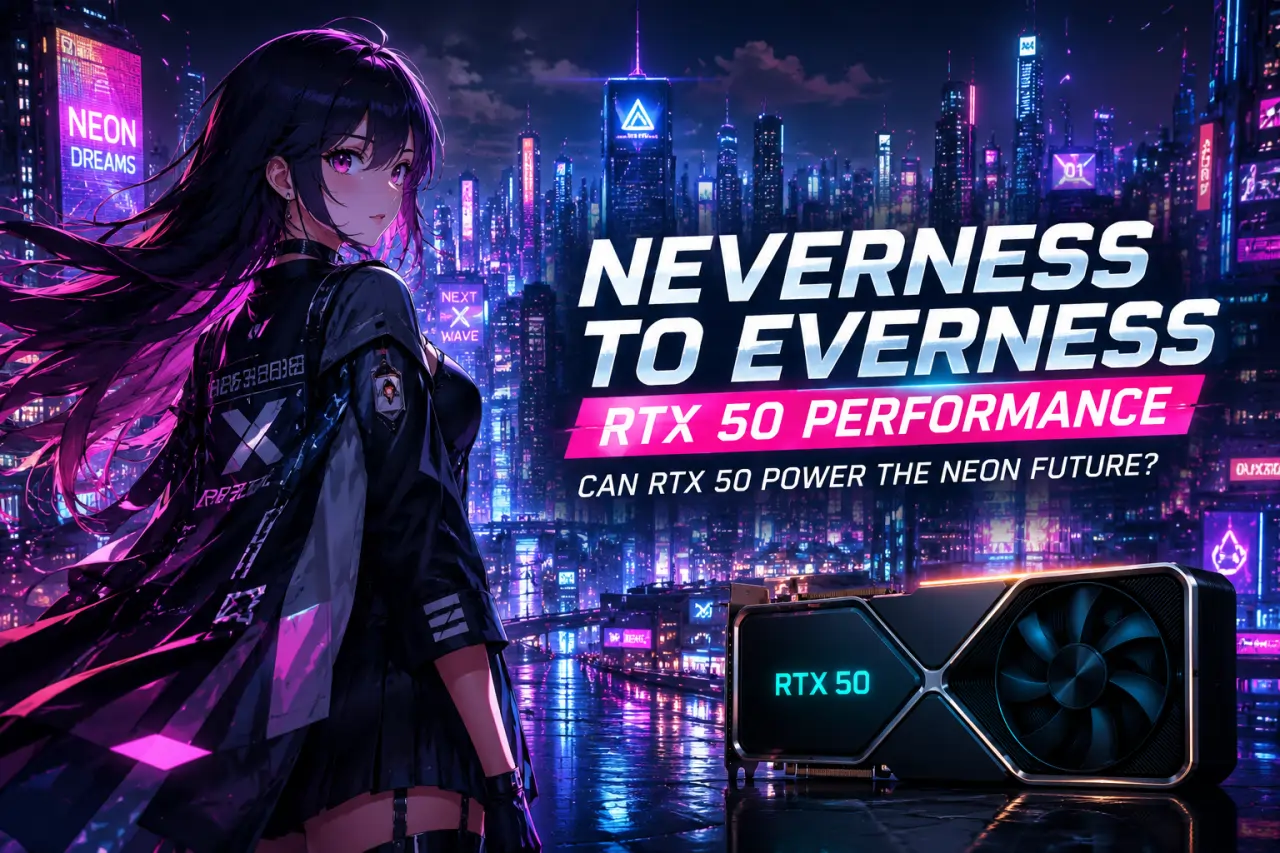
Neverness to Everness RTX 50 Performance: Can NVIDIA’s New GPUs Handle the Ultimate Cyberpunk Anime World?
Neverness to Everness RTX 50 Performance is setting a new benchmark for anime games on PC. Not long ago, most anime titles relied on simple cel-shaded graphics, flat lighting, and static environments that felt more like stage props than living worlds. Developers had to choose between preserving the charm of anime-style characters or creating realistic environments because GPUs simply couldn’t deliver both at the same time.
That trade-off is finally gone.
With the global release of Neverness to Everness, players are seeing what could become the next visual benchmark for anime-inspired open-world games. However, this incredible leap in graphics comes with equally demanding hardware requirements. Thanks to advanced path tracing, cinematic lighting, volumetric effects, and AI-powered rendering, the game pushes modern GPUs to their limits.
That’s exactly where NVIDIA’s RTX 50 Series enters the spotlight. Instead of offering just another performance upgrade, these GPUs provide the horsepower needed to experience Neverness to Everness exactly as the developers envisioned.
Why Neverness to Everness Looks So Different
Blending Neverness to Everness Anime Characters with Photorealistic Environments
One of the biggest technical achievements in Neverness to Everness is how it combines classic anime-style characters with highly realistic city environments.
Previous anime games often struggled with realistic lighting. If lighting became too accurate, characters looked like plastic dolls. On the other hand, simplified lighting made them appear disconnected from the world around them.
Neverness to Everness solves this challenge by using physically based rendering (PBR) throughout its environments. Every surface reacts to light naturally.
Concrete softly diffuses light.
Rain puddles create accurate reflections.
Metal surfaces scatter highlights based on their material properties.
As players explore neon-lit streets, colorful signs cast blue, purple, and pink lighting onto characters. Rather than simply brightening the model, the lighting wraps naturally around clothing, hair, and accessories while producing soft shadows that help characters feel fully grounded inside the environment.
Creating these lighting interactions in real time requires an enormous amount of GPU processing power.
A Virtual Camera That Feels Like Real Photography
Neverness to Everness Cinematic Depth of Field Like a Hollywood Camera
Another standout feature is the game’s camera system.
Instead of using a traditional game camera with everything perfectly sharp, Neverness to Everness simulates professional photography techniques.
During conversations and cinematic scenes, the engine recreates the look of an 85mm portrait lens with a wide aperture. Characters remain razor sharp while the vibrant cyberpunk city behind them melts into beautiful cinematic bokeh.
The simulation goes much further than simple background blur.
The engine also recreates:
- Optical lens distortion
- Chromatic aberration around image edges
- Cinematic key lighting
- Fill lighting
- Rim lighting
- Natural depth compression
Older GPUs typically rely on inexpensive blur filters to fake depth of field.
The RTX 50 Series, however, performs these calculations much more accurately, allowing distant holograms, streetlights, and neon signs to retain their shape and lighting characteristics even while out of focus.
RTX 50 Series Takes Path Tracing to Another Level
Lighting That Behaves Like the Real World
Lighting is arguably the most impressive aspect of Neverness to Everness.
The game relies heavily on path tracing, one of the most advanced rendering technologies available today.
Unlike traditional rasterization, path tracing calculates how light physically bounces between surfaces.
That difference becomes obvious in a dense cyberpunk city.
Hundreds of light sources remain active simultaneously, including:
- Neon advertisements
- Vehicle headlights
- Storefront displays
- Holographic billboards
- Interactive UI elements
Older rendering techniques fake much of this behavior using baked lighting and screen-space reflections. While these methods work reasonably well in static environments, they struggle inside dynamic open worlds with changing weather and day-night cycles.
Thanks to NVIDIA’s next-generation RT Cores, the RTX 50 Series handles these situations far more realistically.
When rain covers the streets, neon reflections accurately ripple across puddles. As players move through the environment, those reflections react naturally to footsteps and splashes.
Global illumination also adds another level of realism.
For example, a giant red holographic billboard doesn’t simply illuminate nearby objects. Its light bounces off walls, reflects from clothing, spreads across nearby surfaces, and even colors the surrounding fog.
The result feels remarkably lifelike.
Volumetric Fog Creates the Cyberpunk Atmosphere
Every Beam of Light Has Real Depth
Another demanding visual feature is volumetric fog.
Instead of placing a flat layer of fog across the environment, Neverness to Everness simulates actual atmospheric density.
As light travels through the fog, it scatters realistically to produce dramatic light shafts, commonly known as “god rays.”
These beams stretch between skyscrapers, illuminate narrow alleyways, and create the moody atmosphere that defines the game’s cyberpunk aesthetic.
Historically, rendering path-traced lighting through volumetric systems has been one of the toughest workloads for any graphics card.
The RTX 50 Series handles these effects smoothly, even during complex scenes packed with lighting and particle effects.
AI Helps Deliver Smooth 4K Gameplay
DLSS and Frame Generation Make the Impossible Possible
Rendering every visual effect at native 4K would overwhelm even today’s fastest graphics hardware.
That’s why NVIDIA combines dedicated Tensor Cores with AI technologies such as DLSS and Frame Generation.
Instead of rendering every frame at full 4K resolution, the GPU first renders the scene internally at a lower resolution, such as 1440p or even 1080p.
DLSS then reconstructs an incredibly detailed 4K image using:
- Motion vectors
- Frame history
- Depth information
- AI image reconstruction
RTX 50 Series goes even further by generating entirely new intermediate frames.
Using advanced AI prediction, the GPU inserts additional frames between rendered ones, significantly increasing frame rates without requiring full traditional rendering for every frame.
The result is impressive.
Players can enjoy cinematic-quality visuals while maintaining refresh rates approaching or exceeding 120 FPS.
For a fast-paced action RPG where dodging, countering, and high-speed movement are essential, that level of smoothness isn’t just nice to have—it directly improves gameplay.
Also read about this article that you might be interest:
NVIDIA RTX Spark: Why it Changes The Local AI Era
RTX Spark Price 2026: Models, Specs, Deals & Buying Guide
Don’t Buy RTX 5060 in 2026 Until You Read This!
What Happens on Older Graphics Cards?
Visual Quality Drops Quickly
Running Neverness to Everness on previous-generation mid-range GPUs often requires significant compromises.
Players may need to disable:
- Path tracing
- High-quality global illumination
- Advanced volumetric fog
- Premium depth of field
Without these features, the game loses much of its visual identity.
Reflections become noticeably flatter.
Shadows appear less accurate.
The city loses much of its atmospheric depth.
Cinematic scenes also suffer as depth-of-field effects degrade into obvious blur artifacts.
By comparison, RTX 50 Series owners experience the game much closer to the developers’ original artistic vision.
Final Verdict: A New Standard for Anime Open-World Games
Neverness to Everness isn’t simply another anime RPG.
It represents a major leap forward for the entire genre.
By successfully combining photorealistic environments with beautifully stylized anime characters, the developers have created a visual experience unlike anything we’ve seen before.
Of course, delivering that level of realism demands equally powerful hardware.
The NVIDIA RTX 50 Series proves why modern GPU architecture matters. With next-generation RT Cores, AI-powered Tensor Cores, advanced path tracing, global illumination, and DLSS Frame Generation, these GPUs transform what once seemed impossible into a smooth, playable experience.
For PC gamers, hardware enthusiasts, and anyone excited about the future of anime-inspired graphics, Neverness to Everness offers a glimpse of what’s next.
The era of visual compromises is ending.
The future is glowing with neon—and it runs best on RTX 50 Series hardware.