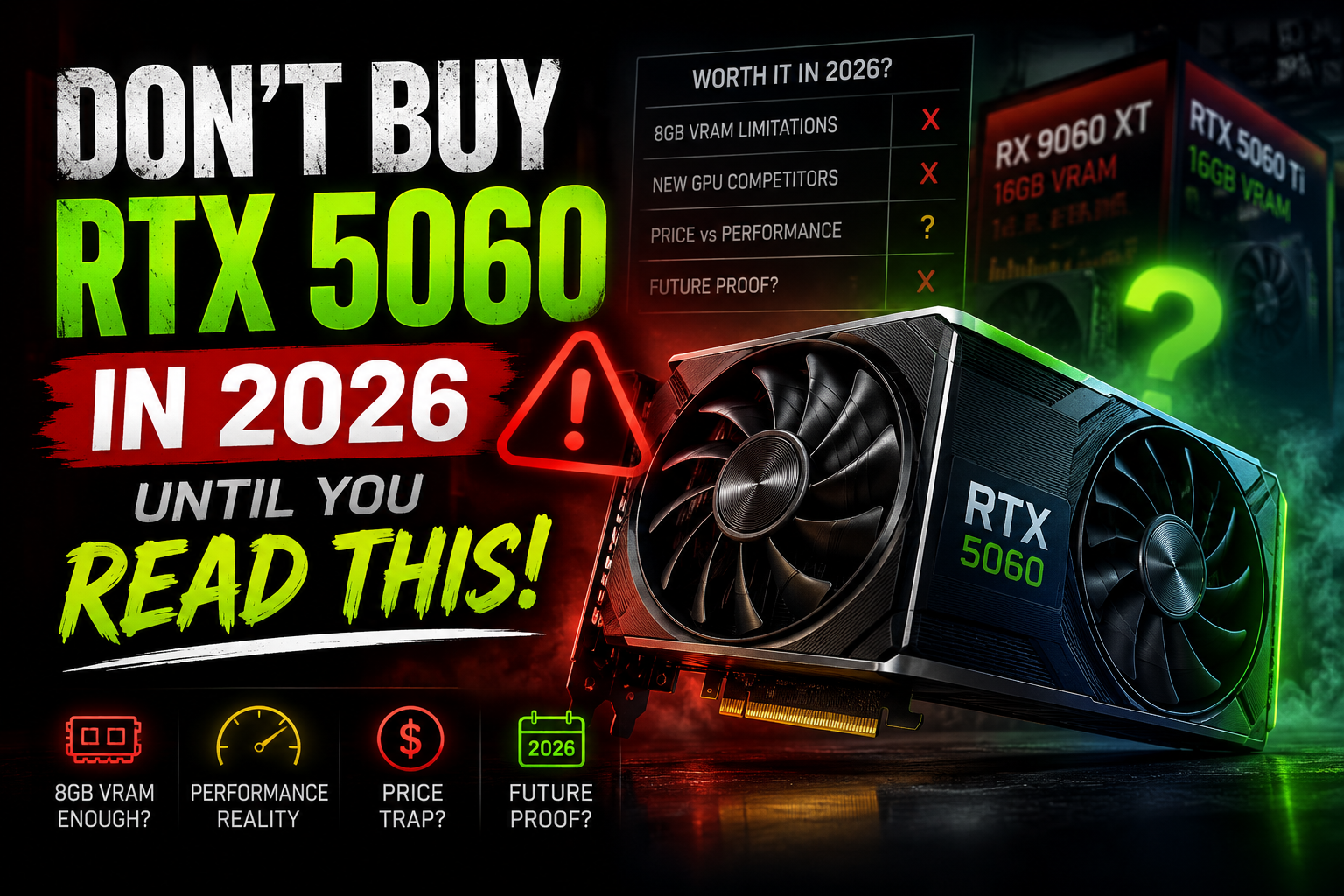
Buy RTX 5060? Read This Review First!
You want to Buy RTX 5060? The GeForce RTX 5060 launched with everything budget PC gamers wanted to hear: Blackwell architecture, blazing-fast GDDR7 memory, DLSS 4 support, and a surprisingly affordable $299 MSRP. On paper, it looked like the perfect upgrade for anyone struggling to maintain smooth frame rates in modern games.
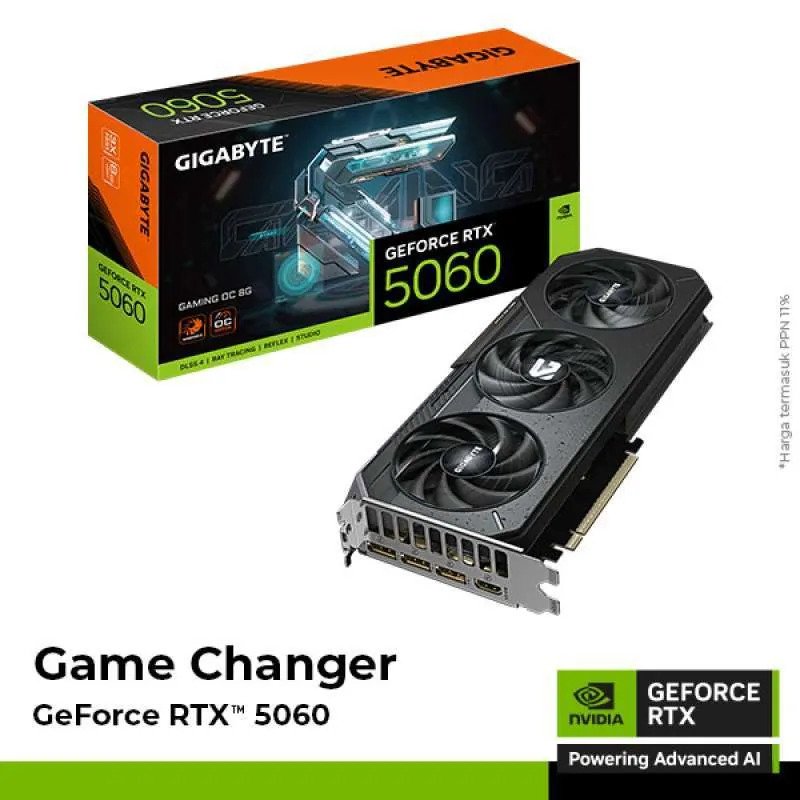
Fast-forward to 2026, and the picture isn’t nearly as simple. After months of real-world testing across today’s most demanding releases, one hardware limitation has become impossible to ignore. While the RTX 5060 excels in the right scenarios, it’s also one of the easiest GPUs to outgrow if AAA gaming is your priority.
The Verdict
The RTX 5060 is a fantastic entry-level GPU for esports and 1080p gaming, but its 8GB of VRAM makes it a risky long-term investment for modern AAA titles. If your budget can stretch another $70–$130, you’ll get much better longevity with a 12GB or 16GB alternative.
Gameplay & Mechanics
Unlike reviewing a game itself, reviewing a graphics card comes down to one thing: how well it keeps your gameplay smooth. In lighter titles, Buy RTX 5060 absolutely delivers.
Games like Valorant, Counter-Strike 2, League of Legends, Fortnite, and Apex Legends run effortlessly at high refresh rates. The gameplay loop stays buttery smooth, input latency remains low, and the GPU barely breaks a sweat.
The experience changes once you fire up today’s biggest AAA releases. Open-world games built on Unreal Engine 5 and other modern engines can easily push beyond the RTX 5060’s available VRAM, leading to texture streaming issues and noticeable hitching. Average FPS numbers might still look impressive, but those sudden frame drops can ruin an otherwise smooth session.
Buy RTX 5060 Get This Visuals & Performance
The RTX 5060 is built on Nvidia’s Blackwell architecture and brings several meaningful upgrades over the RTX 4060.
| Specification | RTX 5060 | RTX 4060 | RTX 5060 Ti |
|---|---|---|---|
| Release Date | 2025 | 2023 | 2025 |
| Launch Price | $299 | $299 | $379 (8GB) / $429 (16GB) |
| Architecture | Blackwell | Ada Lovelace | Blackwell |
| CUDA Cores | 3,840 | 3,072 | 4,608 |
| Memory | 8GB GDDR7 | 8GB GDDR6 | 8GB / 16GB GDDR7 |
| Memory Bandwidth | 448 GB/s | 272 GB/s | 448 GB/s |
| Power Draw | 145W | 115W | 180W |
The jump in memory bandwidth is impressive. Combined with additional CUDA cores, the RTX 5060 often delivers a 25% to 30% performance boost over the RTX 4060 in older DirectX 12 games and synthetic benchmarks.
The problem isn’t speed—it’s capacity. But Buy RTX 5060 is still worth considering.
The 8GB VRAM Problem
Eight gigabytes used to be plenty for 1080p gaming. In 2026, that’s no longer true.
Modern games are designed around current-generation consoles that effectively have access to much larger memory pools. Once a PC title demands more than 8GB of texture data, the RTX 5060 has to move assets into system RAM over PCIe.
That’s where performance falls apart.
Instead of simply losing a few frames, you’ll notice stutters, inconsistent frame pacing, and ugly 1% lows whenever new assets stream into memory. Even if your FPS counter shows 80 or 90 FPS, those random hiccups are impossible to ignore during gameplay.
DLSS 4: Incredible Technology With One Catch
DLSS 4 remains one of Nvidia’s strongest selling points.
Frame Generation can dramatically improve perceived smoothness, especially in demanding games. It can transform a game rendering around 40 FPS into something that feels much closer to 90 FPS, making demanding titles far more enjoyable.
The catch is that Frame Generation also consumes additional VRAM.
Depending on the game, enabling DLSS 4 can use anywhere from roughly 800MB to 1.5GB of memory. If your game is already sitting close to the 8GB limit, turning on DLSS 4 can actually push the card over the edge and trigger the very stuttering you’re trying to eliminate.
It’s an unfortunate trade-off that becomes increasingly common in newer releases.
Also Read this Article:
Hong Kong AI Hardware Revolution 2026: Biggest Innovations Changing the Future
Story & Long-Term Value
Every hardware launch tells a story, and the RTX 5060 is a reminder that raw bandwidth doesn’t automatically solve memory limitations.
Blackwell is a genuinely impressive architecture. Power efficiency is excellent, ray tracing performance continues to improve, and DLSS 4 remains one of the best AI-powered features available on PC.
Unfortunately, pairing all of that technology with only 8GB of VRAM makes the card feel like it was built for yesterday’s games instead of tomorrow’s.
If your gaming library is mostly competitive shooters or indie titles, you may never notice the limitation. If you’re planning to spend the next several years exploring blockbuster RPGs with Ultra textures enabled, the RTX 5060 starts feeling dated much sooner than its specs suggest.
If You Want to Buy RTX 5060 Check Better Alternatives
If your budget has a little flexibility, there are stronger long-term options.
Buy RTX 5060 Ti 16GB is the obvious upgrade for players who want to stay within Nvidia’s ecosystem. The extra memory dramatically improves future-proofing while letting DLSS 4 operate without constantly fighting for VRAM.
It’s also worth checking clearance deals on RTX 4070 models. Thanks to their 12GB memory configuration, they often outperform the RTX 5060 in demanding native rendering despite belonging to the previous generation.
Whether you’re shopping through Steam, the PlayStation Store, Xbox Games Store, or Nintendo eShop for your next blockbuster, newer games will only continue demanding more graphics memory. Buying hardware that can keep up is money well spent.
Pros & Cons
Pros
- Excellent 1080p esports performance
- Strong Blackwell architecture improvements
- Fast GDDR7 memory
- DLSS 4 support is genuinely impressive
- Efficient 145W power consumption
- Great option for compact PC builds
Cons
- 8GB VRAM is increasingly restrictive
- Noticeable stuttering in memory-heavy AAA games
- DLSS 4 can increase VRAM usage
- Limited long-term value for Ultra settings
- Better options exist with 12GB or 16GB memory
Final Score
Rating: 7.8/10
The RTX 5060 isn’t a bad graphics card—it just serves a much narrower audience than its marketing suggests.
If your daily rotation revolves around competitive games, older titles, or you’re upgrading from aging hardware like a GTX 1660 or RTX 2060, you’ll likely be thrilled with the performance. It’s efficient, quiet, and offers excellent value for high-refresh 1080p gaming.
For everyone else, especially players chasing the latest AAA releases with ray tracing and maxed-out textures, the 8GB VRAM limit is difficult to recommend in 2026. Spending a little more on a 12GB or 16GB GPU today could save you from frustrating performance bottlenecks tomorrow.
For most buyers, the RTX 5060 is a good graphics card—but not the smartest long-term investment.
You can also try watch deep review on Youtube