OpenAI VS Nvidia Blackwell: Why OpenAI’s New AI Chip Has Silicon Valley Talking
For years, one truth in the AI industry felt unshakeable: if you wanted to run cutting-edge AI, you bought Nvidia chips. That assumption just got its first real crack. In late August 2026, OpenAI unveiled benchmark results for its first custom-built AI chip, and the numbers directly challenge Nvidia’s Blackwell lineup — the same chips currently powering most of the world’s large AI models.
The comparison of OpenAI vs Nvidia Blackwell is quickly becoming one of the biggest storylines in tech this year, not just because of the performance claims, but because of what it signals: the company that arguably started the modern AI boom no longer wants to depend entirely on Nvidia to run it.
Here’s what actually happened, what the numbers mean, and why it matters even if you’ve never thought about a semiconductor in your life.
Meet Jalapeño: OpenAI’s First Homegrown AI Chip
OpenAI’s new chip has a spicy name — “Jalapeño” — and an unusually direct target: Nvidia’s dominance over AI inference hardware. Unlike a general-purpose GPU, Jalapeño is purpose-built for one job only: inference, which is the process of actually running an already-trained AI model to answer a question or generate a response.
That distinction matters a lot. Training a model — the process of teaching it from scratch on massive datasets — is still Nvidia’s stronghold, and nothing about Jalapeño changes that. But inference is the part of AI that regular people interact with every single day: every ChatGPT reply, every AI customer service chat, every AI-generated image request is an inference workload. And as AI usage scales into the billions of daily interactions, inference is becoming the more expensive, more frequent, and arguably more important cost center for AI companies.
Jalapeño wasn’t built alone. OpenAI co-developed the chip with Broadcom, handling the core silicon and networking design, while Celestica handled systems integration. The project traces back to an October 2025 deal between OpenAI and Broadcom to jointly build out 10 gigawatts of custom AI accelerators — a scale that hints at just how serious OpenAI is about reducing its reliance on outside hardware vendors.
The Benchmark Numbers: How Jalapeño Stacks Up Against Blackwell
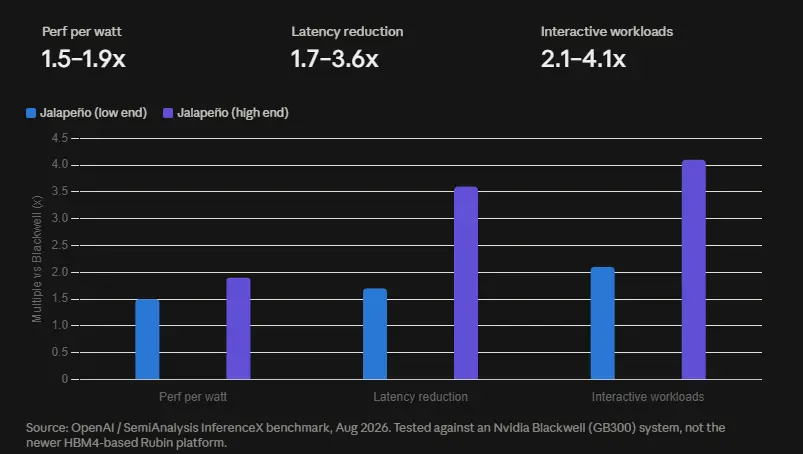
OpenAI presented its first public benchmark results at the Hot Chips conference on August 25, 2026, using SemiAnalysis’s independent InferenceX benchmark suite. The tests ran across three different large language models — GPT-OSS 120B, DeepSeek R1 670B, and Kimi K2.5 1T — to keep the comparison model-agnostic rather than tuned specifically to OpenAI’s own systems.
The headline results:
- 1.5x to 1.9x more AI work per watt at peak throughput compared to Nvidia Blackwell-generation systems
- 1.7x to 3.6x lower end-to-end latency, meaning faster responses
- 2.1x to 4.1x higher performance specifically on ultra-low-latency, interactive workloads — the kind that matter most for chatbots and AI agents
SemiAnalysis, the research firm that verified some of the benchmark runs on-site, didn’t hold back its reaction. Analyst Dylan Patel called the results “huge news,” noting that it’s unusual for a company’s first-generation custom chip to beat an established, mature product like Blackwell at all — let alone by this margin. In a blog post, SemiAnalysis summed it up bluntly: “Jalapeño smokes every other chip” on the performance-per-watt metric.
Each Jalapeño rack reportedly packs 128 accelerators, delivering 1.7 exaFLOPS of 4-bit compute, 27.5 TB of HBM4 memory, and just under 2 petabytes per second of memory bandwidth — figures that put it firmly in the same weight class as Nvidia’s most advanced systems.
Also read related article about AI:
NVIDIA RTX Spark: Why it Changes The Local AI Era
Hong Kong AI Hardware Revolution 2026: Biggest Innovations Changing the Future
Why Jalapeño Is So Efficient
Part of Jalapeño’s edge comes down to a design philosophy focused on minimizing wasted movement of data. In its own blog post, OpenAI explained the goal was to “minimize data movement and communication delays,” keeping a model’s short-term “working memory” — technically called the KV cache — physically close to the compute hardware during a response, rather than shuttling it back and forth across a system.
In plain English: less data has to travel further, so fewer delays pile up, and the chip does more useful work per unit of electricity it consumes. That efficiency gain is exactly why the “performance per watt” metric matters so much in this story — in an industry where AI data centers are increasingly constrained by power availability rather than raw chip supply, squeezing more intelligence out of every watt is arguably more valuable than raw horsepower.
The Catch: This Comparison Isn’t Fully Apples-to-Apples
Before declaring Nvidia dethroned, it’s worth being clear-eyed about the caveats — and there are several important ones.
First, SemiAnalysis itself flagged that the comparison is “somewhat incomplete and unfair” in Jalapeño’s favor, because it uses newer HBM4 memory, while the Blackwell systems it was benchmarked against use older memory technology. A fairer like-for-like comparison would be against Nvidia’s upcoming Vera Rubin platform, which also uses HBM4 — and Jalapeño hasn’t been tested against that yet. Early indications suggest Jalapeño still edges out Vera Rubin on output tokens per megawatt, even though Nvidia’s chip uses an optimization technique (multi-token prediction) that Jalapeño hasn’t adopted. On total cost of ownership per token, however, the two reportedly come out roughly even.
Second, the tests excluded certain techniques like speculative decoding, and OpenAI didn’t disclose full system-level power consumption in every comparison, meaning some of the throughput numbers should be read with a bit of caution.
Third — and perhaps most importantly — Jalapeño only handles inference. It cannot train frontier AI models. For the extremely compute-intensive, large-scale training runs that produce the next generation of AI models, analysts widely agree Nvidia’s GPUs remain essential, thanks to their broad programmability, mature software ecosystem (CUDA), and proven ability to handle diverse workloads. TrendForce analyst Fion Chiu put it simply: OpenAI’s chip could reduce reliance on Nvidia for inference over time, but for training, “we believe Nvidia GPUs will remain important.”
Finally, deployment is still early-stage. Jalapeño is planned for only very small-scale production by the end of 2026, with broader rollout expected in 2027. It remains, for now, an engineering sample proving a concept rather than hardware running at massive scale.
Not Everyone Is Convinced
Reactions across the industry have been mixed. Yole Group technology analyst Adrien Sanchez told CNBC that a “hyperscaler-designed chip can now match or beat Nvidia’s Blackwell-class GPUs on inference efficiency” — but he also noted Nvidia still commands the “vast majority” of AI compute worldwide and benefits from deep ecosystem lock-in through CUDA, its dominant software platform that most AI developers already build on.
On the more skeptical side, CNBC’s Jim Cramer dismissed the idea that Nvidia faces any real competitive threat, a view shared by some investors who point out that previous attempts by other tech giants to build competitive in-house AI chips have quietly stalled despite having similar cost incentives to succeed.
What This Means for the Industry
Regardless of where you land on the debate, the timing of OpenAI’s announcement was notable — it landed just one day before Nvidia’s fiscal second-quarter earnings report, though analysts were quick to note this alone wouldn’t meaningfully move Nvidia’s already-locked-in results.
The bigger picture is this: OpenAI’s chip effort now looks like a credible independent performance play, not just a defensive hedge against relying on a single supplier. It also puts a spotlight on inference economics specifically — the ongoing, recurring cost of running AI, as opposed to the one-time cost of training it. As AI products scale to serve hundreds of millions of users daily, inference efficiency increasingly determines profit margins, not just model quality.
For now, Nvidia’s position at the top of the AI hardware stack isn’t going anywhere overnight — its software ecosystem, breadth of compatibility, and dominance in training workloads remain enormous competitive moats. But the OpenAI vs Nvidia Blackwell benchmark battle marks the clearest signal yet that the AI hardware market is no longer a one-horse race. The real test will come with independent, third-party benchmarking and actual large-scale deployment in 2027 — that’s when we’ll find out whether Jalapeño’s lab-bench lead becomes a genuine fleet advantage.
Source: Official Youtube Meteoz Hub