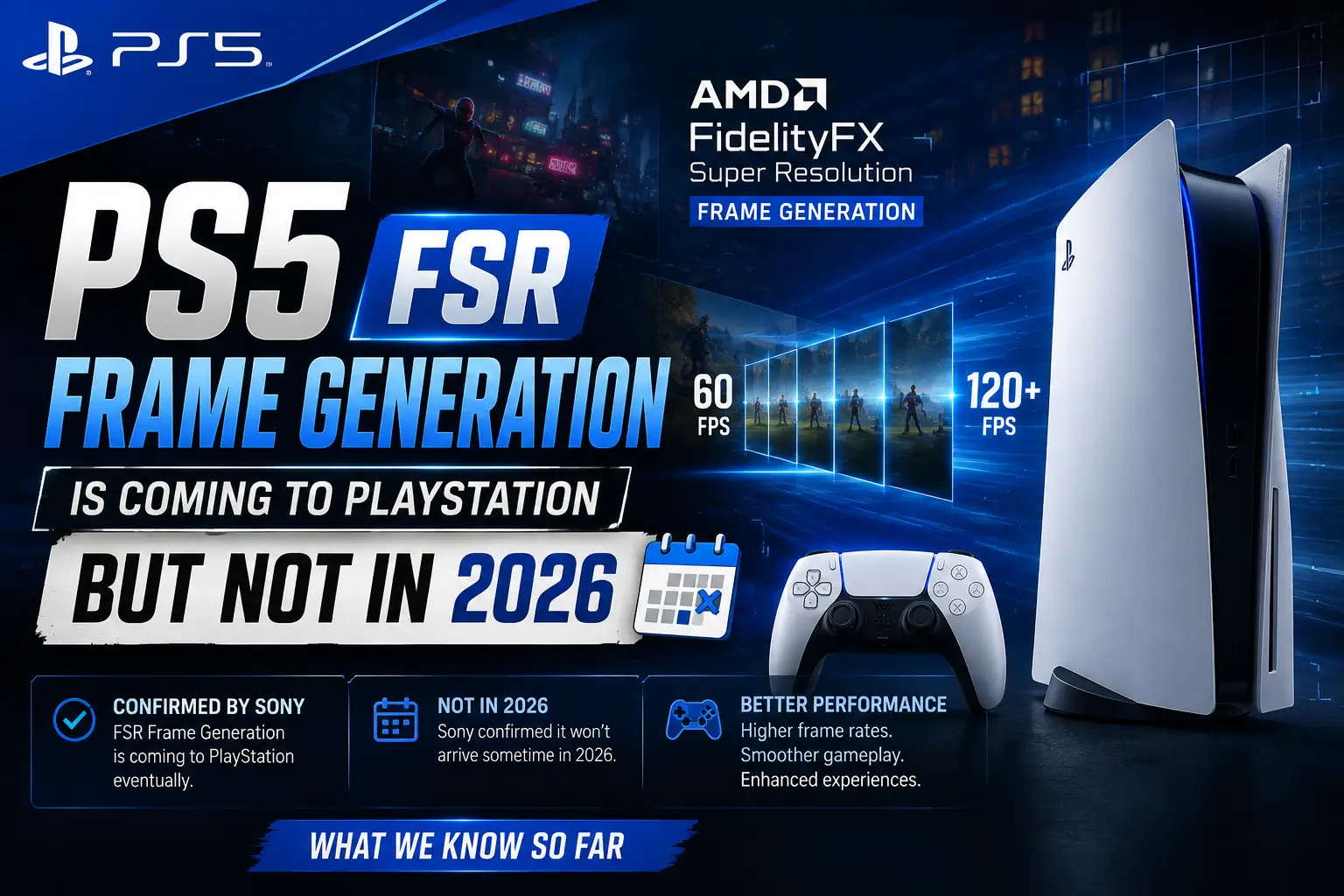
PS5 FSR Frame Generation: What We Know So Far (And Why You Shouldn’t Get Your Hopes Up for 2026)
If you’ve been scrolling gaming Twitter or Reddit lately, you’ve probably seen the buzz. Sony just confirmed that PS5 FSR Frame Generation is officially in the works. Yeah, that AI-powered tech that basically fakes extra frames to make your games feel buttery smooth? It’s coming to PlayStation. Eventually.
But before you start dreaming about buttery 120 FPS runs of your favorite games, let’s pump the brakes a little. Sony also confirmed this isn’t happening in 2026. So what’s actually going on here, and why should you care? Let’s break it down.
Wait, What Even Is PS5 FSR Frame Generation?
Quick refresher for anyone who’s not knee-deep in GPU tech talk. Frame Generation is AMD’s answer to Nvidia’s DLSS 3 Frame Generation. Instead of your console or GPU rendering every single frame from scratch, the AI steps in and generates brand-new frames that sit in between the “real” ones.
So if your game is chugging along at 40 FPS, frame gen can make it feel like 80 or even higher, at least on paper. It doesn’t actually boost your GPU’s raw horsepower. Instead, it’s more like a really convincing magic trick that smooths out motion and makes everything look and feel snappier on a 120Hz TV.
This tech has already been a huge deal on PC through both DLSS and FSR 3. Now, according to PS5 and PS5 Pro system architect Mark Cerny, it’s finally headed to PlayStation in a proper, native form.
Sony Just Confirmed It. Here’s the Receipt
This isn’t some random leak or a rumor cooked up from a datamine. It came straight from Cerny himself in a deep-dive interview with Digital Foundry. He confirmed that PS5 FSR Frame Generation is real, and it’s built on genuine co-engineered tech between Sony and AMD.
Cerny explained that FSR Frame Generation is based on technology co-developed between Sony Interactive Entertainment (SIE) and AMD, and that an equivalent frame generation library should eventually show up on PlayStation platforms. He even said he’s happy with how the work is progressing so far, which is honestly a pretty solid sign that this isn’t vaporware.
That said, when Digital Foundry pushed him on specifics, like which PlayStation platforms would actually get it first, Cerny couldn’t give a straight answer. He didn’t confirm whether the PS5 Pro would get it, or whether this is really being saved for the next-gen PS6. That vagueness is doing a lot of heavy lifting here, and it’s the main reason fans shouldn’t expect this feature to drop anytime soon.
The Part Everyone’s Bummed About: Not in 2026
Here’s the reality check. Cerny was crystal clear that Sony has no more major console software releases planned for the rest of 2026. So whatever timeline you had in your head for PS5 FSR Frame Generation, push it back. Way back.
Some outlets are even speculating this feature might not land until 2027 at the earliest, and there’s a real chance it debuts alongside the PS6 instead of showing up as a PS5 or PS5 Pro update. That would line up with recent PS6 leaks suggesting Sony’s next console is aiming for major performance jumps, including 4K 120 FPS gameplay across most titles.
So yeah, if you were hoping this drops as a surprise firmware update this holiday season, that’s not happening. Manage those expectations accordingly.
- Is GTA 6 Worth $1,000 in Gear? Let’s Do the Math
- Omniscient Reader’s Viewpoint 2027: Anime Release Leaked
- Xbox Elite Controller S3: Release Date, Leaks & Features
- PS5 FSR Frame Generation: What We Know So Far?
- GTA 6 Release Date Is Set — Is Your Wallet Ready?
How This Ties Into Project Amethyst
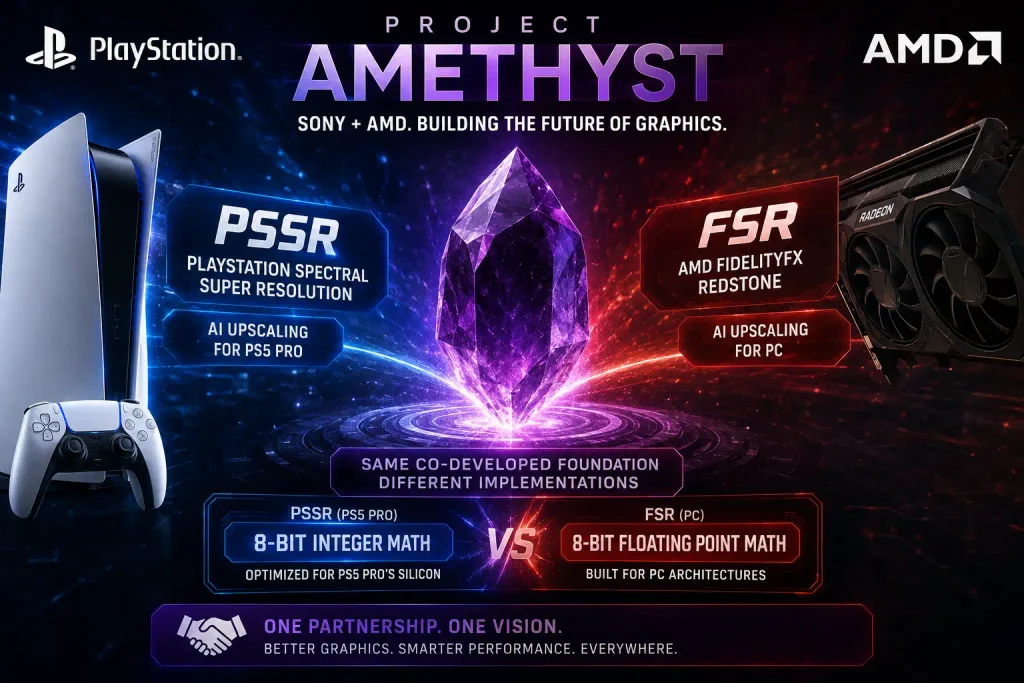
None of this is coming out of nowhere. Sony and AMD have been quietly building toward this moment through something called Project Amethyst, a collaboration that kicked off back in 2023. The goal has always been to develop smarter, more efficient graphics tech that both companies can use across their own platforms.
We’ve already seen fruits of that partnership. PSSR (PlayStation Spectral Super Resolution), Sony’s AI upscaling tech for PS5 Pro, actually shares its core algorithm with AMD’s FSR Redstone upscaling on PC. Cerny confirmed the two use the same co-developed foundation, though the implementations differ because of hardware differences. FSR on PC leans on 8-bit floating point math, while PSSR runs on 8-bit integer math, tuned specifically for the PS5 Pro’s silicon.
That distinction matters because it shows this isn’t Sony slapping a PC feature onto a console and calling it a day. It’s a genuinely custom-built solution, which also explains why it’s taking a while to finish.
Frame generation is the next logical piece of that puzzle. Once Sony nails the upscaling side with PSSR, layering AI-generated frames on top is the natural next step, especially since both companies are already building toward FSR Diamond (aka FSR 5), the next-gen upscaling and frame gen suite meant to power future Radeon GPUs, Xbox’s Project Helix, and Sony’s own next-gen console efforts.
What This Could Actually Mean for Players
Let’s talk practical impact for a second, because the specs alone don’t tell the whole story. If Sony pulls this off well, a game that’s internally rendering at 30 or 40 FPS could feel like a smooth 60 or even 120 FPS experience once frame generation kicks in. On a 120Hz OLED or QLED TV, that’s the difference between choppy, judder-heavy motion and a genuinely fluid picture.
For PS5 Pro owners specifically, the combo of upgraded PSSR upscaling plus native frame generation could unlock visual and performance targets that just weren’t realistic on console hardware before. Think ray-traced, cinematic-quality games running at frame rates that used to be a PC-only flex.
Of course, frame generation isn’t magic, and PC gamers already know the tech has its quirks. Input latency, visual artifacts around fast motion, and diminishing returns at lower base frame rates are all real issues that AMD and Nvidia are still working through. Sony will need to solve those problems too, or risk shipping a feature that looks great in marketing screenshots but feels off in your hands.
Should You Wait for PS5 FSR Frame Generation?
Honestly, probably not, at least not if you’re deciding whether to buy a PS5 or PS5 Pro right now. This feature is confirmed to exist, but it’s still early days, and Sony hasn’t locked down a release window beyond “not 2026.” If you need a new console today, buy based on what’s actually available now, not on a promise that could land in a year or two, or possibly with the PS6 instead.
That said, this is genuinely exciting news for the long-term health of the PlayStation ecosystem. It shows Sony is serious about closing the performance gap with high-end PC gaming, and the fact that this tech is co-engineered with AMD (rather than a rushed in-house workaround) is a good sign for quality.
The Bottom Line
PS5 FSR Frame Generation is real, it’s confirmed, and it’s coming from a legit AMD-Sony partnership under Project Amethyst. But 2026 is officially off the table, and there’s a decent chance this feature debuts with the PS6 rather than as a PS5 Pro update. For now, all we can do is wait, keep an eye on future Digital Foundry interviews, and hope Sony nails the execution when it finally arrives.
We’ll keep this article updated as more details drop, so bookmark it if you want to stay in the loop on everything PS5 FSR Frame Generation related.
Source: PS5 Official Website & AMD Official Website